Hoffman, Mann on “Luck”; review

Santa Anita is fantastic,” says Michael Mann of the iconic horse race track in Arcadia, Ca. “It’s beautiful, a great-looking race track; why would you choose any other place?”
That’s high praise from the filmmaker responsible for the TV and movie versions of “Miami Vice,”  the seven-time Oscar nominee “The Insider,” and the cult favorite “Heat.”
“Santa Anita is such a beautiful atmosphere; it would be crazy not to honor it,” adds David Milch, Phi Beta Kappa and Summa Cum Laude graduate of Yale. Milch went on to be an Emmy-winning writer of “Hill Street Blues” and then co-created “NYPD Blue,” for which he won a Humanitas Prize and a record 26 Emmy nominations in the first season, and created the HBO series “Deadwood,” winner of Emmys, a Golden Globe, and a Peabody Award.

Scott Hettrick

Scott Hettrick

Mann and Milch, unlikely partners as two of three executive producers of the new HBO series about the underbelly of horse racing called “Luck” (9 p.m. ET/PT on Sunday nights beginning January 29) joined the show’s two highest-profile stars, Dustin Hoffman and Nick Nolte, on a panel during HBO’s presentation at the Television Critics Association tour Friday in Pasadena.
<Story continues along with review of all nine episodes of “Luck” below the following 85-second video interview with Hoffman and Mann…>

Get the Flash Player to see this content.
Series creator and writer Milch, a longtime race horse owner and self-confessed near-obsessive race track bettor has a reverence for Santa Anita that is conveyed visually in the pilot directed by Mann and throughout each of the nine episodes of the series.

My father took our family to a movie in 1969 starring Steve McQueen called “The Reivers,” an adaptation of the William Faulkner novel, featuring slow-motion scenes of horses racing that Dad thought represented some of the most impressive cinematography he had ever seen.
I think he would have thought the same about the powerful scenes of horse racing at Santa Anita in “Luck.”

But even some of those who follow horse racing and are familiar with Santa Anita expressed disappointment with the one-hour pilot that HBO showed as a sneak preview last month. Too many characters and too much insider jargon that combined to make it a little hard to follow, and nothing much of significance happening which made it feel a little slow and not very engaging. Providing even more challenge in the pilot, most of the characters are degenerates and criminals who don’t initially exude much charisma or humor, though they do each have personalities that will eventually emerge.

For those viewers who were not bowled over by the pilot, I recommend sticking with it with a few more episodes; the second hour ramps up considerably, even if it is still not “The Sopranos.” In fact, mob-like violence eventually creeps in during later episodes, particularly as Hoffman’s character, who is being released from prison in the first scene of the pilot, becomes entangled by episodes four and five with a yacht-residing heavy rival for Hoffman’s Ace character played by Michael Gambon (the polar opposite of his avuncular Professor Dumbledore in the “Harry Potter” movies).
It is that juxtaposition of the seedy side of horse racing set against the idyllic ambiance of Santa Anita that offers the primary intrigue and focus of the show. Milch described it as the “double-ness” of Santa Anita, the real world and the “Santa Anita of the mind.”

The momentum of the mid-series episodes, including a mild earthquake tremor that literally shakes up the motley crew while dining at the local “Rod’s Grill” near the track, tends to stall a bit before regaining energy in the final installment.

Along the way, despite the multitude of characters already in place, new high-profile actors like Gambon continue to be added, such as Joan Allen. Her role as a persistent horse welfare activist (a la Bo Derek?) and her motivation is as vague as many of the other characters, but she appears to become a potential romantic interest for Ace.

Another actor gaining screen time after the pilot is Hall of Fame former jockey Gary Stevens (“Seabiscuit”), whose story arc carries him through a recurrence of his battle with alcoholism that threatens his career. Stevens displays an impressive and extensive range of acting skills that his prior acting roles had not allowed.

For Hoffman, the series presents a new opportunity to work unencumbered by studio executives.
“I’ve not had this experience before,” he said. “You can’t get a shot at doing your best work in the studio system.”
HBO does not have committees analyzing and making recommendations, he said. He also enjoys having three cameras filming at the same time to catch different angles so that actors don’t have to repeat the same shot multiple times.

Also somewhat unique to this HBO series is the wide variance in running times of each “one-hour” episode by as much as 20-minutes.” Each episode has a different director and some run about 45-minutes while others run 50-plus minutes and 60-plus minutes, including the 66-minute finale.

Hoffman and the producers all expressed interest in seeing the expensive series be picked up by HBO for several more seasons.
Maybe that would give Milch time to write in a visit to Santa Anita from Tony Soprano or even Carrie and friends from that other former HBO series “Sex and the City.”

– By Scott Hettrick

Cameron: $18 mil on Titanic 3D

Filmmaker James Cameron is spending $18 million and a full year converting “Titanic” from 2D to 3D.
Although he acknowledges that 2D-to-3D conversion is, and will continue to improve, filmmaker James Cameron says it will never be as good as shooting in 3D, noting that even with that kind of time and financial investment in “Titanic 3D,” it will still only be 90% as good as if he had shot it in 3D to begin with, he said in a pre-lunch Keynote address at the annual 3D Entertainment Summit at the Hollywood & Highland center. “It’s just 2.2 or 2.4,” he said.

Also working against conversion for a filmmaker, Cameron said, is having to spend months focusing entirely on depth issues of shots you already filmed, as opposed to having 3D simply be one of many elements of the shooting process during initial production.

See Cameron’s full comments on the topic in the following 90-second video below (Three other James Cameron videos here.)…

– By Scott Hettrick

Get the Flash Player to see this content.

Cameron: 60 frames best for 3D

Increasing frame-rate of filming and projection from century-old 24 frames-per-second to 48-fps or even 60-fps will make a dramatic difference in film experience and eliminate issues for most of those people who are physically impacted by 3D, and it’s all easily do-able and cost-effective with digital cameras and projectors, filmmaker James Cameron said during his pre-lunch Keynote presentation at the annual 3D Entertainment Summit at the Hollywood& Highland center Wednesday (Sept. 21).

See Cameron’s explanation in three-minute video highlights below (Three more James Cameron videos here.)…

– By Scott Hettrick

Get the Flash Player to see this content.

Cameron: TV will drive 3D

As soon as the TV industry gets 3D right, it will quickly become a pervasive success across all mediums and every movie will be made in 3D, filmmaker James Cameron said Wednesday (Sept. 21) during a presentation at the annual 3D Entertainment Summit at the Hollywood & Highland center.

That success will depend on broadcasters learning to produce programs in 3D and 2D with a single production set-up that can deliver in both formats, he said.
<Cameron’s comments in 1-minute video highlights below… (See three more James Cameron video highlights here.) >
– By Scott Hettrick

Get the Flash Player to see this content.

Cameron: Avatar needed more 3D

James Cameron wishes he would have pushed the depth and impact of 3D further with “Avatar” and is doing so with his conversion on “Titanic,” the filmmaker said Wednesday (Sept. 21) at the 3D Entertainment Summit at the Hollywood & Highland Center.
He was overly cautious with his 2 1/2-hour movie for fear of eye fatigue, which he now understands is not an issue when 3D is presented properly.
<Other notable comments made by Cameron following 2-minute video highlights below …  (three other James Cameron videos here) >…

Get the Flash Player to see this content.

Other notable comments by Cameron during his appearance in a pre-lunch Keynote presentation at 3D Entertainment Summit:

* Negative media stories about 3D do not reflect realty of 3D revenue success which is up 40% year-over-year for last four years with projections for similar increase in coming months/years.

* 3D being punished for its own success because limited number of 3D screens result in reduced percentage of 3D grosses for each movie when there are unprecedented number of 3D movies in release simultaneously.

* Any film will look better in 3D.

* Impact of 3D greatest on small, intimate dramas.

– By Scott Hettrick

“Cars2″ actors on games, 3D

3DHollywood.net partner GamerLive.TV sat down with “Cars 2” actors and filmmakers to discuss the movie, games, and 3D.
Three videos below, beginning with Eddie Izzard and Owen Wilson:

Director John Lasseter:

and Larry the Cable Guy and Emily Mortimer:

Eye-opening Arabia via IMAX 3D

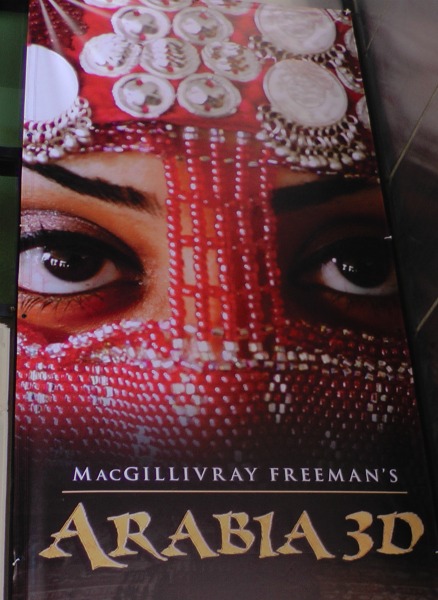
“Arabia 3D” represents the first major film production filmed entirely in Saudia Arabia, the first to feature aerial photography of some of the country’s mosques and world’s largest gathering of humans — 3 million Muslims in the annual hajj pilgrimage — and one of the few films to showcase the culture’s 2,000-year history that included a reign as the hub of the Islamic Golden Age featuring the development of algebra, optics, hospitals and the scientific method.

All this in 45-minutes, in giant IMAX, and in 3D, at the California Science Center beginning this weekend and running for several months.
And once again IMAX showcases 3D as it should be presented, creating a completely immersive experience to the point that you even feel as if the sand is blowing inches from your face.

<Story continues following the 3-minute video interview below with “Arabia 3D” filmmaker Greg MacGillivray, who explains why IMAX 3D is the only format getting 3D right.>

Get the Flash Player to see this content.

Say Saudia Arabia to most people these days and they will think primarily of turban-wearing people riding camels and living in desserts counting their billions of dollars from the oil beneath the sand.
Others may think of Muslims and associate them with terrorists.

It was these one-dimensional stereotypes and misconceptions that people and businesses of Saudia Arabia, including oil companies, sought to change through a film that could paint a more layered and comprehensive portrait of the Arabian culture. Longtime IMAX filmmaker Greg MacGillivray, who directed photography for “The Towering Inferno” and Stanley Kubrick’s “The Shining” before spending the next 35 years producing and directing spectacular and award-winning IMAX films such as “Everest” and “Grand Canyon,” accepted the challenge to spend four years on “Arabia 3D.”

The challenges included shooting in a country that has no cinema infrastructure and has not allowed cameras near most anything. And these were not ordinary cameras — they were extraordinarily large IMAX cameras with 3D that shoot only 3-minutes of film before requiring reloading.

The result is a movie filled with fascinating and enlightening historical and contemporary context and anecdotes as conveyed through narrators such as Helen Mirren and three contemporary citizens, including the most engaging one, a film student at Chicago’s DePaul University who is tracked as he returns to his homeland to make his own movie about the country.

While it can be a little slow and dry at times, no joke intended, the enormous amount of in-depth research that went into “Arabia” is clear and presented well, and the photography and 3D is stunning. That photography includes From multiple shots of camels doing that tri-fold thing with their legs every time they want to simply lay down; underwater 3D exploration of shipwrecks of the Red Sea; and ultimately the staggering shots in the holy city of Mecca and the masses of humanity winding through a circle of ceremony.

Everyone will learn a lot about the Arabian culture, and hopefully Hollywood mainstream filmmakers will learn how 3D should be produced.

– By Scot Hettrick

Cameron-Bay 3D, Trans III

James Cameron and Michael Bay discuss 3D filmmaking at Paramount Studios in this 3-minute highlight video below..

Pirates Preem: Dis Chan 3D?

Along the world’s longest red carpet (well, black, actually) for the world premiere of “Pirates of the Caribbean: On Stranger Tides” that took up all of Main Street at Disneyland Saturday night, we heard a couple interesting tidbits (story continues following video highlights below the first of three that features shots of all the stars of “Pirates” on the carpet and interviews with mermaids, pirates and the famous villainous monkey, as well as stars from American Idol and Dancing with the Stars… )

Get the Flash Player to see this content.

.
* Disney Channel may be the next TV franchise to go 3D. Disney-ABC Television Group president Anne Sweeney told us would be her best guess as to the next 3DTV target for the House of Mouse (see video below featuring interview with Sweeney and Walt Disney Co. President/CEO Robert Iger).
.
* Disney Imagineer Tony Baxter alluded to the next big thing after Cars Land opens in 2012 at California Adventure — an attraction at Disneyland, and likely tied to a major motion picture to debut in a couple years. Surely he must be talking about the long-delayed cinematic adaptation of “Jungle Cruise,” which was reported last month to have attached Tom Hanks and Tim Allen as stars. One wonders what they have in mind for a makeover of the venerable ride. (See interview with Tony as well as the heads of Disneyland and all Disney resorts discussing the upcoming opening of the revamped Star Tours with 3D and 54 variations, as well as legendary Disney archivist Dave Smith below).

The following 3-minute video features interviews with Disney parks executives and archivist Dave Smith…

Get the Flash Player to see this content.

The following 2-minute video features interviews with Disney Co. President and CEO Robert Iger and Disney-ABC Television Group President Anne Sweeney…

Get the Flash Player to see this content.


– By Scott Hettrick

Historical Foo Fighters 3D

It was already going to be a long night with two back-to-back cinema events and it got started a little late but the sold-out crowd at Mann’s Chinese Theatre in Hollywood on Tuesday night (April 5) didn’t seem to mind at all.

That’s because this was a crowd of die-hard Foo Fighters fans who are used to sitting far longer for a live concert, and that’s what this was, a live concert experience broadcast by Cinedigm Digital Cinema to 80 digital theaters, and delivered for the first time in 3D.
<Story continues below the following video highlights of the event in Hollywood.

>
Get the Flash Player to see this content.

The evening began with producer Nigel Sinclair (“No Direction Home: Bob Dylan”) of Exclusive Media’s Spitfire Pictures, and Oscar/Emmy-winning documentary producer/director James Moll introducing the commercial premiere of the profile of the evolution of the band’s ever-changing line-up, “Foo Fighters: Back and Forth.” The film then runs at 10 p.m. ET/PT Friday, April 8, on VH1 Rock Doc, VH1 Classic, and Palladia.
The film was co-financed by Exclusive Media Group and RCA Records and produced by Spitfire Pictures in association with Allentown Productions.

After a brief intermission following the film’s cinema presentation Tuesday, the Foo Fighters introduced themselves from a undisclosed location in Northridge, Ca., where they performed their entire new album being released April 12, “Wasting Light,” with little more than a couple seconds in between each song, and almost no comments or acknowledgment of the live audience watching except for a hello and a goodbye.

– By Scott Hettrick

Get Adobe Flash playerPlugin by wpburn.com wordpress themes